A rock star swims for her life. A past resurfaces.
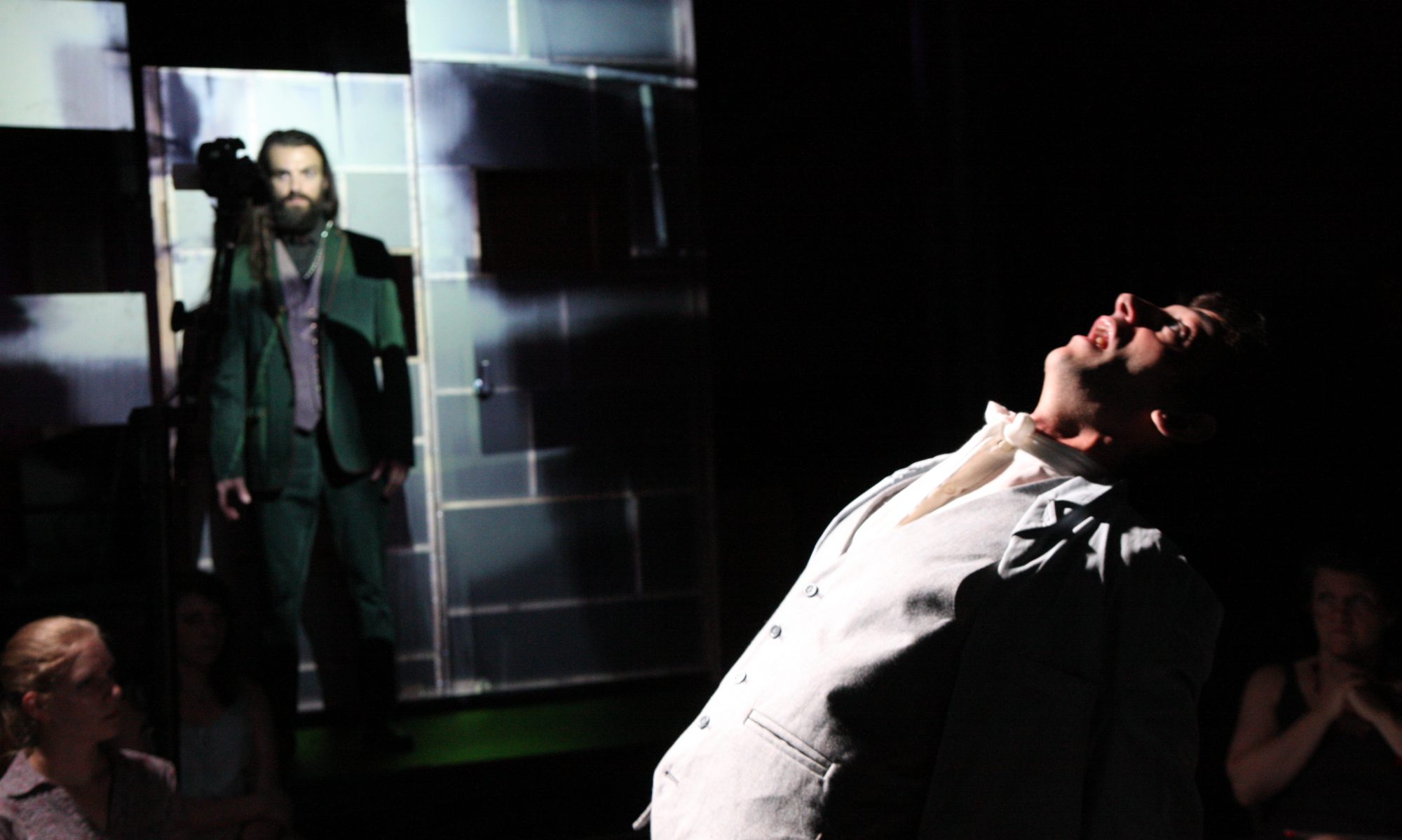
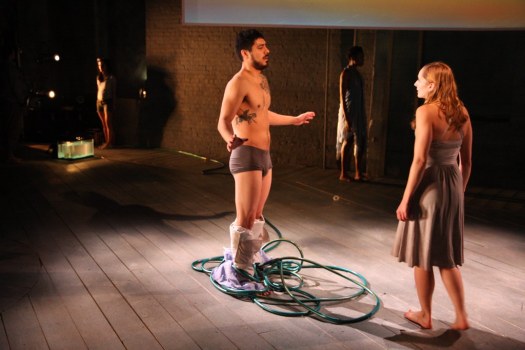
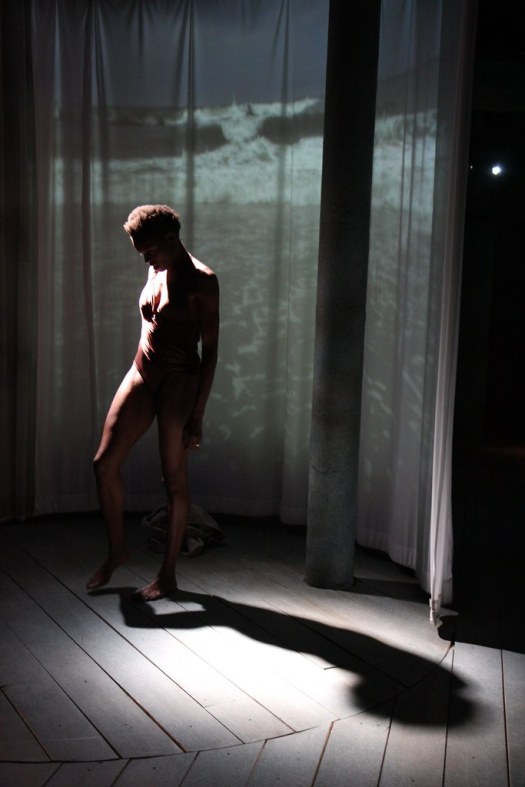
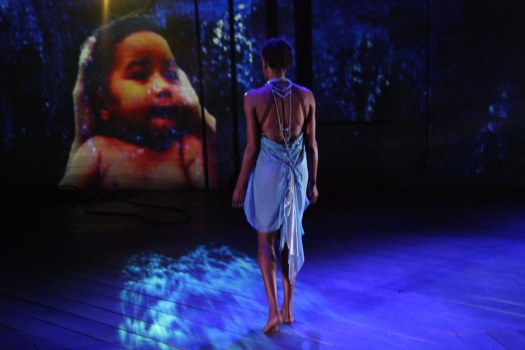
Rock goddess Leda feels it coming, from deep down, from the ocean. It won’t bow to her grief. Hear it? Lust, longing, life, chaos. The music. The Stranger. SOUNDING is a new cross-disciplinary production for seven characters that pays homage to Ibsen’s LADY FROM THE SEA. Live cinema surges onto stage in this multi-media play set to an original soundtrack inspired by Patti Smith, Bartok and Portishead. Written by Jennifer Gibbs and directed by Kristin Marting. Featuring Okwui Okpokwasili. February-March 2010.
“With its visual and aural onslaught, SOUNDING is a feast for the senses…Marting’s masterful production is punctuated by gorgeous pop-rock interludes…Okpokwasili mesmerizes us with her smoky voice and stunning presence.” – TimeOut New York
1991 After spending a year adapting Dostoevsky’s epic novel, THE POSSESSED, with my collaborator Robert Lyons, I began rehearsal with a 14 person cast. About a week into rehearsal when we began the process of taking exploratory work and translating it into staging, I began to instinctually feel the space for the first time as a director. In the past, I had intellectually analyzed the space and made my choices. It was liberating and thrilling to instinctually feel what the strongest choice spatially was.
1997. My dance-theatre adaptation of Canadian novelist Marie Claire Blais’ first work, MAD SHADOWS, was centered on an intelligent but ugly girl’s relationship with her hatefully vain and shallow family and her attempt to create her own better family. I had been exploring using a gestural vocabulary in my work since 1991. But this project, aided by a long eighteen-month development process using the same strong cast, enabled me to create a very deep work that fused gestures and emotions. The jarring, flailing but still stylized gestures of a girl in unbearable pain brought her agony home with our audiences.
2005. Although I had worked with media before, I first began deeply integrating media on DISPOSABLE MEN, a solo work by James Scruggs about the representation of African-American men in our culture. We used original, found, and live feed video projected onto cylindrical, fabric and flat screens as well as projecting onto the performer’s body. It was really exciting to uncover how much we could amplify our message by mixing image and performance together. Even more exciting was examining my own perspective as a white woman by this piece dealing with tensions between black men and white women.
“…This stunning multimedia performance piece Disposable Men demonstrates the socially transformative work that theater can do.” ––talkinbroadway.com
Taylor Mac as Orpheus and Katy Cunningham, Arie Thompson and Nina Mankin as the Sirens of the Underworld. – photo by David Morris
2004. This is an image from ORPHEUS, a music theatre show that I directed a few years ago. ORPHEUS was a true hybrid collaboration of music, text, dance, and media. It was co-conceived by myself, the set designer and lighting designer. Once we created the concept and outline, we invited the other collaborators into a consensus-based process (writer, composer, video artist and costume designer). I really felt like we were able to achieve a rich and beautiful visual and auditory world through this team effort. I’m still haunted by the image of the denizens of the underworld singing to Orpheus “don’t look back,” and yet he does.
ORPHEUS looks at grief and how difficult it can be to overcome. We started making this project in NYC soon after 9/11 because we wanted to find a visceral way to explore unresolved grief for our community. We found our way in through music and by stretching the boundaries of music-theatre. We hit on setting it in an underground nightclub for the recently departed with strict entry policies and rules. We positioned the audience as recent arrivals – instead of a ticket, each was issued a honey cake and coin to get past the bouncer Charon – and were served drinks from the rivers of the underworld to ease their passage into forgetfulness. Scattered about the club at tables, banquettes and chairs, the audience was surrounded by the Shades, memory-troubled dead whom our hostess Persephone (backed by her trio of burlesque siren-enforcers) soothes by erasing painful memories of the lives they have left behind (these memories are represented as video sequences projected onto the Shades’ bodies). We defined the charismatic Orpheus as a famous pop singer who has broken the rules (by entering the club still alive) and his newly departed bride Eurydice as a birdwatcher. In our version of the myth, Orpheus is forced to choose between his art and his love. His grief at Eurydice’s death gives him new expression and artistry in his music, which he knows he will lose if she comes back to life. When Orpheus looks back at the end, it is an articulation of the struggle between these two competing desires.
Audiences responded enthusiastically to the show and I received numerous comments on how the images and songs stayed with them and sparked new ideas about grief. Despite the favorable response, we felt that we didn’t quite realize the piece’s full potential and have recently decided to revisit the text and music. I keep planning to revisit this rich material with this amazing group, but haven’t done so yet.
“If you are of the ilk who enjoys the dream-like depths of David Lynch, the sheer giddiness of symbolism from Peter Greenaway, and the emotional ponderings of Hal Hartley, you should run, not walk to see Orpheus.” —newyorkcool.com
(RUS)H – Lathrop Walker, Marc Bovino, Luis Vega and Dax Valdes- photo by James Scruggs
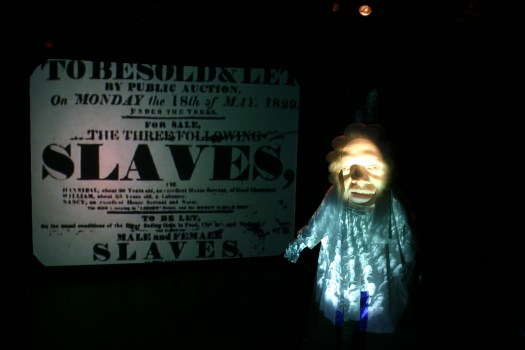
2008. With the multimedia (RUS)H, James Scruggs and I were wrestling with the idea of sensation in our de-sensitized world: how far are you willing to go to feel something? Told in a non-linear format with text, dance, movement, media and music, we wove together the fragmented memories of a man, his wife and the unlikely man he befriends. In order to reveal the emotional underbelly of the characters, we developed experimental video puppets just for this project. This was a real trial-and-error process, which involved six prototypes, three different approaches to the media content, and numerous work-in-progress showings. We integrated text, gesture, salsa, tango, and fight choreography with complex video imagery. To spark dialogue with our audiences about the central issues in the work, we organized three panel discussions which included passionate conversations among artists, panelists and audiences.
“The ride… is dark, thrilling, and remarkably fresh in its visual and dramatic conception. A haunting production that looks strikingly novel, even as it explores issues of betrayal and identity central to the theatrical tradition.” – Brooklyn Rail





 Kristin Marting